
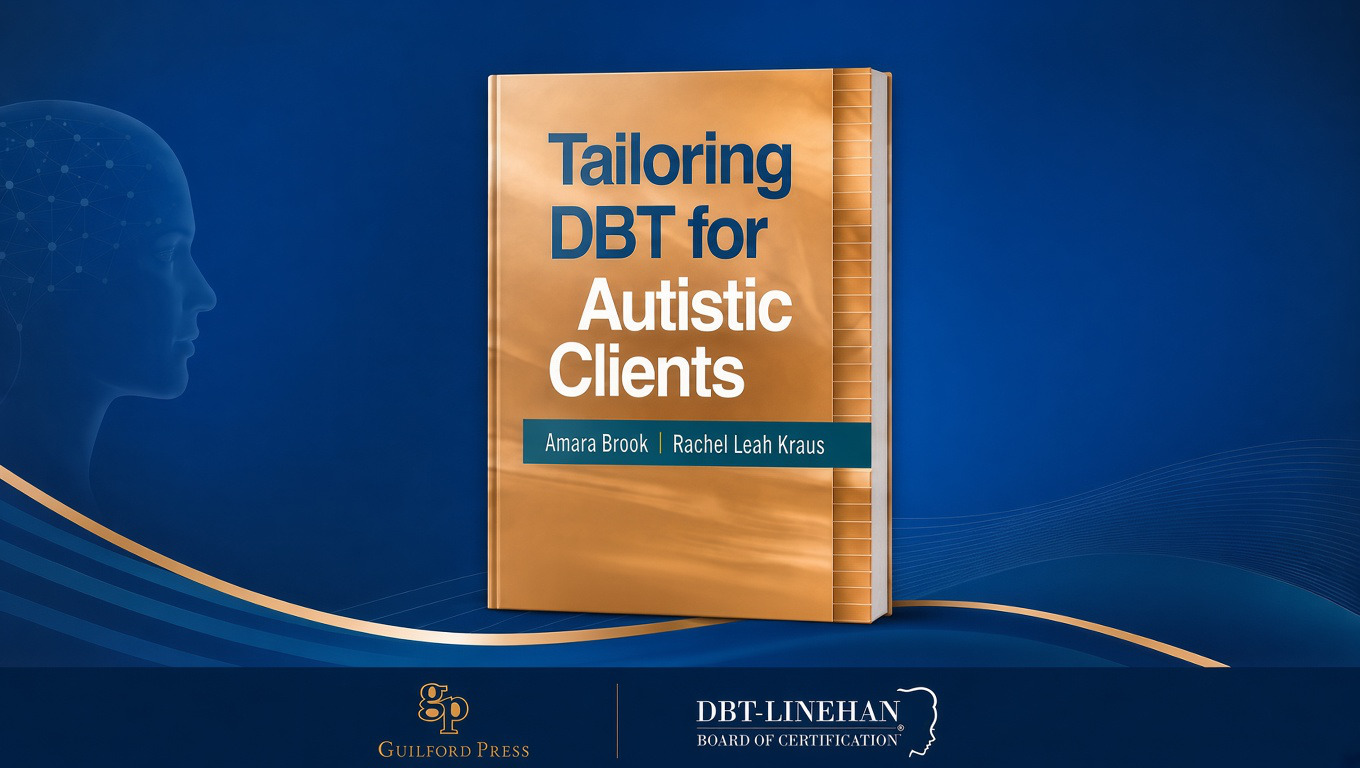
Authors in conversation on Neurodiversity-Affirming DBT
If you work with Autistic clients, or simply want to continue growing as a DBT clinician—Tailoring DBT for Autistic Clients, by Amara Brook, PhD, ABPP, and Rachel Kraus is a resource you will want on your bookshelf. It can be said unequivocally: it’s a must-read for DBT clinicians.
Advancing Neurodiversity-Affirming DBT
One of the strengths of DBT is its ability to balance adherence to an evidence-based treatment with responsiveness to the individual. Tailoring DBT for Autistic Clients provides clinicians with a thoughtful framework for doing exactly that.
Rather than presenting an entirely different treatment, Brook and Kraus explore how clinicians can thoughtfully tailor DBT for Autistic clients while maintaining fidelity to the treatment.
The book encourages clinicians to consider how differences in communication, sensory experiences, emotional processing, executive functioning, and social experiences may influence how an Autistic person experiences DBT. It also encourages clinicians to examine the assumptions they may bring into treatment and consider how a clinical approach can become more accessible, collaborative, and neurodiversity-affirming.
The Importance of Neurohumility
One concept that is particularly noteworthy is neurohumility. As clinicians, expertise may exist in DBT, behavioral principles, and evidence-based treatment. But clients remain the experts on their own lived experiences.
Neurohumility asks clinicians to remain curious about those experiences rather than assuming they understand them based on a diagnosis or their clinical training.
Clinicians can maintain fidelity to an evidence-based treatment AND recognize that effective treatment sometimes requires thoughtful adaptation. Both can be true.
A Conversation With the Authors
Dr. Vay recently sat down with Amara Brook, PhD, ABPP, and Rachel Kraus to talk more about their book, Tailoring DBT for Autistic Clients, and their work to help clinicians provide more neurodiversity-affirming DBT.
The conversation provides an opportunity to hear directly from the authors about the ideas behind the book and what they hope DBT clinicians take from their work.
Interview Details
- 🎥 Interview: Tailoring DBT for Autistic Clients – Author Conversation
- 👤 Presenters: Amara Brook, PhD, ABPP, and Rachel Kraus
Continuing to Grow as DBT Clinicians
You do not have to specialize in autism to benefit from this book. It challenges clinicians to think more carefully about how they conceptualize behavior, establish treatment goals, communicate with clients, and determine when adaptations may be appropriate.
Being an effective DBT clinician requires more than learning skills and following the principles. It requires a willingness to continue examining clinical assumptions, listening to the people being served, and allowing new research and perspectives to inform clinical practice.
Guilford Press deserves recognition for continuing to make resources like this available and supporting the ongoing growth of the DBT community.
If you work with Autistic clients—or simply believe that being a DBT clinician means never stopping learning—Tailoring DBT for Autistic Clients deserves a place on your reading list.
Dr. Vay would also like to extend appreciation to Amara Brook, PhD, ABPP, and Rachel Kraus for sharing their expertise and contributing to the ongoing conversation around neurodiversity-affirming DBT.
Be sure to check back for more exclusive interviews and webinars with leading voices in DBT and neurodiversity-affirming care.